ServicesExtractions
Children's Tooth Extractions in Mansfield Center
When a tooth can't be saved, we take it out calmly and carefully, at a pace your child can handle. You see the X-ray, hear why removal is the right call, and get the scope and cost in writing before anything begins.
When taking a tooth out is the right choice
Most baby teeth loosen and fall out on their own, and we would rather keep a tooth than remove it. An extraction makes sense when decay has gone too deep for a filling or a pediatric crown, when an infection has reached the bone around the root, when a baby tooth is stuck and blocking the adult tooth beneath it, or when an orthodontist needs room in a crowded mouth.
Before we schedule anything, we walk you through the X-ray and explain what we see. You leave with a written quote that lists the extraction itself, the numbing or sedation option we suggest, and whether your child may need a space maintainer afterward. If a repair is a reasonable choice, we tell you that instead.
With kids, how the visit feels matters as much as the result. We use simple, kind words, avoid surprises, and stop to check in often.
What an extraction with us includes
An exam and X-ray first
We look at the root, the bone around it and the adult tooth developing underneath. That picture tells us whether the tooth truly needs to come out and how simple the removal will be.
A written scope and quote
You get every part of the plan on paper before the appointment: which tooth, the comfort option, any follow-up, and the cost of each. Nothing gets added on the day without a conversation with you first.
Slow, careful numbing
We start with a flavored numbing gel on the gum, then give the local anesthetic slowly so it barely registers. We wait until the area is fully numb before we begin.
Comfort options for anxious kids
Some children do best with extra help relaxing. If that fits your child, we explain the choices on our Sedation Dentistry page and include them in your written quote.
Planning for the gap
When a baby molar comes out years early, nearby teeth can drift into the space and crowd the adult tooth. We check whether a space maintainer is worth it and tell you plainly if it isn't.
Aftercare in writing
You go home with clear instructions on bleeding, food, brushing and pain relief, so you are not trying to remember everything from the chair.
Signs your child may need a tooth removed
Two rows of front teeth
An adult tooth coming in behind a baby tooth that won't budge is common in the lower front. If the baby tooth stays firm for several weeks, it may need a little help.
A bump or swelling on the gum
A small pimple-like spot near a tooth often means an infection is draining from the root. Some of these teeth can be treated, others can't, and the X-ray tells us which.
A tooth broken below the gum
Deep decay or a fall can leave too little tooth above the gumline to hold a filling or crown.
A toothache that keeps coming back
Pain that wakes your child at night or lingers after eating should be checked soon. We will look first at whether a root canal could save the tooth.
Crowding flagged by an orthodontist
Sometimes a tooth is removed to make space for straighter, healthy teeth. We coordinate with your child's orthodontist so the right tooth comes out at the right time.
How the visit goes
- 1
Your phone call
We register your child as a new patient, ask about their health history and any medications, and set up an exam.
- 2
Exam, X-ray and written plan
We confirm the tooth needs to come out, talk through the options with you, and hand you the written quote. You decide when to go ahead.
- 3
Getting comfortable
We explain each step to your child in plain words, apply the numbing gel, and give the anesthetic slowly. Most baby teeth need only local numbing.
- 4
Removing the tooth
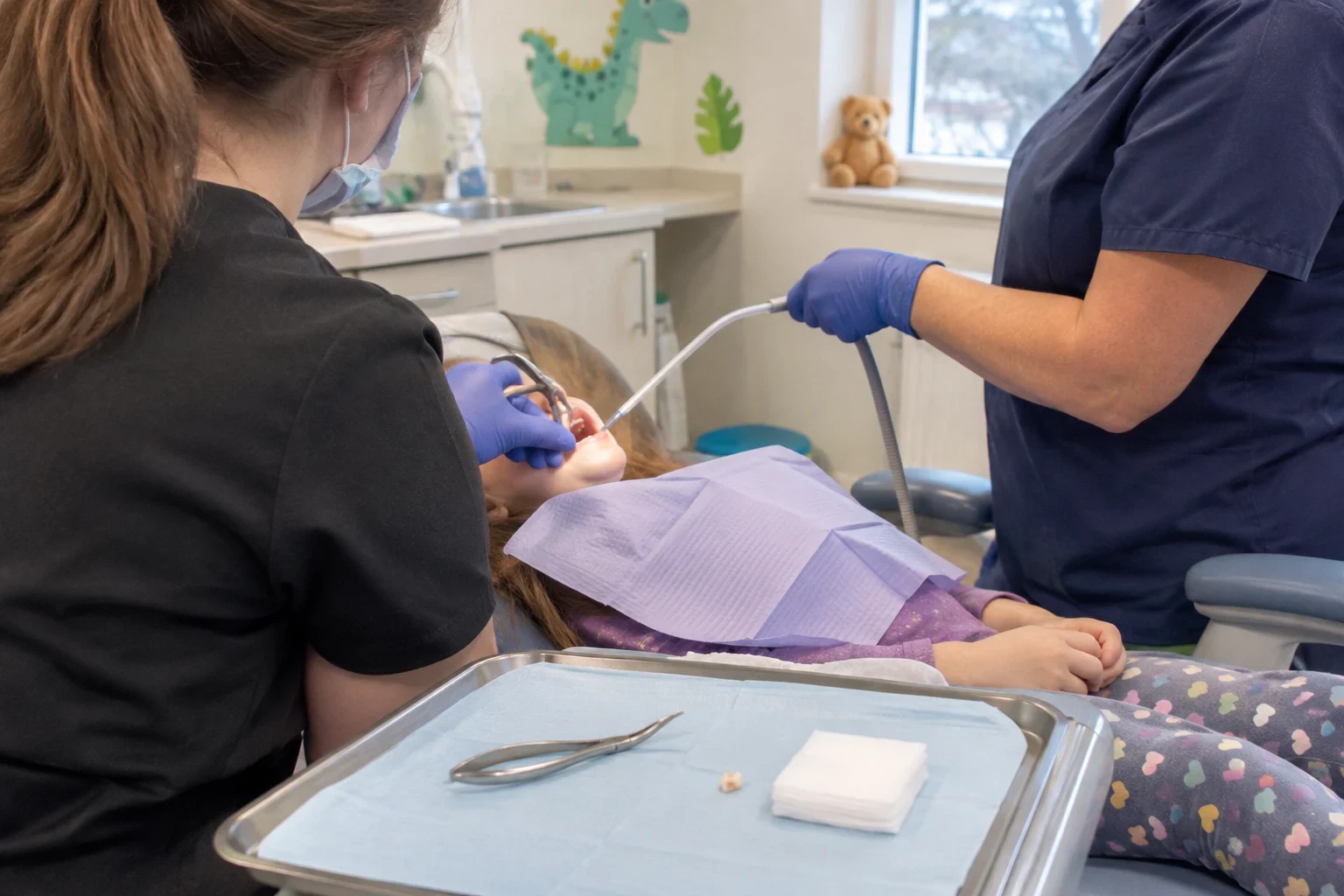
We loosen the tooth gently and lift it out. Your child bites on soft gauze for a short while, and many kids are surprised it is already over.
- 5
Going home and following up
We review the aftercare sheet with you and answer questions. If a space maintainer is part of the plan, we schedule that fitting before you leave.
What shapes the cost of an extraction
Three things drive the price: the tooth itself, how it sits in the jaw, and what your child needs to feel at ease. We write each of those out in your quote before the appointment, so you can review the full amount ahead of time and ask about any line. We accept MasterCard, Visa, Discover, most insurance plans and CareCredit Patient Payment Plan.
- Simple or surgical removal
- A wobbly baby tooth usually lifts out in moments. A tooth snapped off at the gumline, or an adult tooth with long roots, calls for a slower, more involved approach, and the quote reflects that.
- How many teeth come out
- Taking out several teeth in a single sitting can spare your child extra trips to the chair. Each tooth still appears as its own line, so you can see exactly what you are paying for.
- Comfort and sedation
- Local numbing on its own is the less costly route. Sedation adds to the total, and we recommend it only when it genuinely helps your child get through the visit.
- A space maintainer afterward
- When one is needed, it sits on a separate line so that part of the cost is easy to pick out.
- Your insurance plan
- Benefits differ from plan to plan. We share what we expect your coverage to pay, without making promises on your insurer's behalf.
Questions parents ask about extractions
Something not covered here? (508) 682-5283
Will my child feel pain during the extraction?
Your child should notice pressure, not sharp pain. We numb the area completely and test it before we begin. Some soreness for a day or so is normal, and the pain relief listed on the aftercare sheet keeps most kids comfortable while the spot heals.
Why remove a baby tooth that will fall out anyway?
An infected baby tooth can damage the adult tooth developing underneath and keep causing pain. A baby tooth that refuses to loosen can steer the adult tooth out of position. When a tooth can safely be left to come out by itself, we will say so.
What should my child eat after an extraction?
For the first day, stick with gentle, cold or room-temperature choices such as smoothies eaten with a spoon, mashed potatoes, scrambled eggs or oatmeal that has cooled. Hold off on straws and steaming drinks for about a day so the clot can settle in. Most kids are back to their usual meals within a few days.
Does every extraction need a space maintainer?
No. Front baby teeth, and teeth already close to falling out, rarely need one. A space maintainer is most useful when a back baby molar is lost years before the adult tooth is ready to come in.
How can I help my child feel ready?
Keep your language calm and simple, and skip words like shot or pull. Leave the explaining to us in the chair, since we have kid-friendly ways to describe each step. A favorite stuffed animal or blanket is always welcome.
Get a clear plan before any tooth comes out
Families from Mansfield, Easton, Norton and nearby towns can register by phone and book an exam. We will look, explain what we find, and give you the plan in writing.